cloud computing
Observability for AI-Powered Cloud
Why AI cloud observability is the foundation for scaling machine learning, autonomous agents, and AI-driven services without losing control.
AI Cloud Observability: Why It’s the First Priority for AI-Powered Cloud Companies
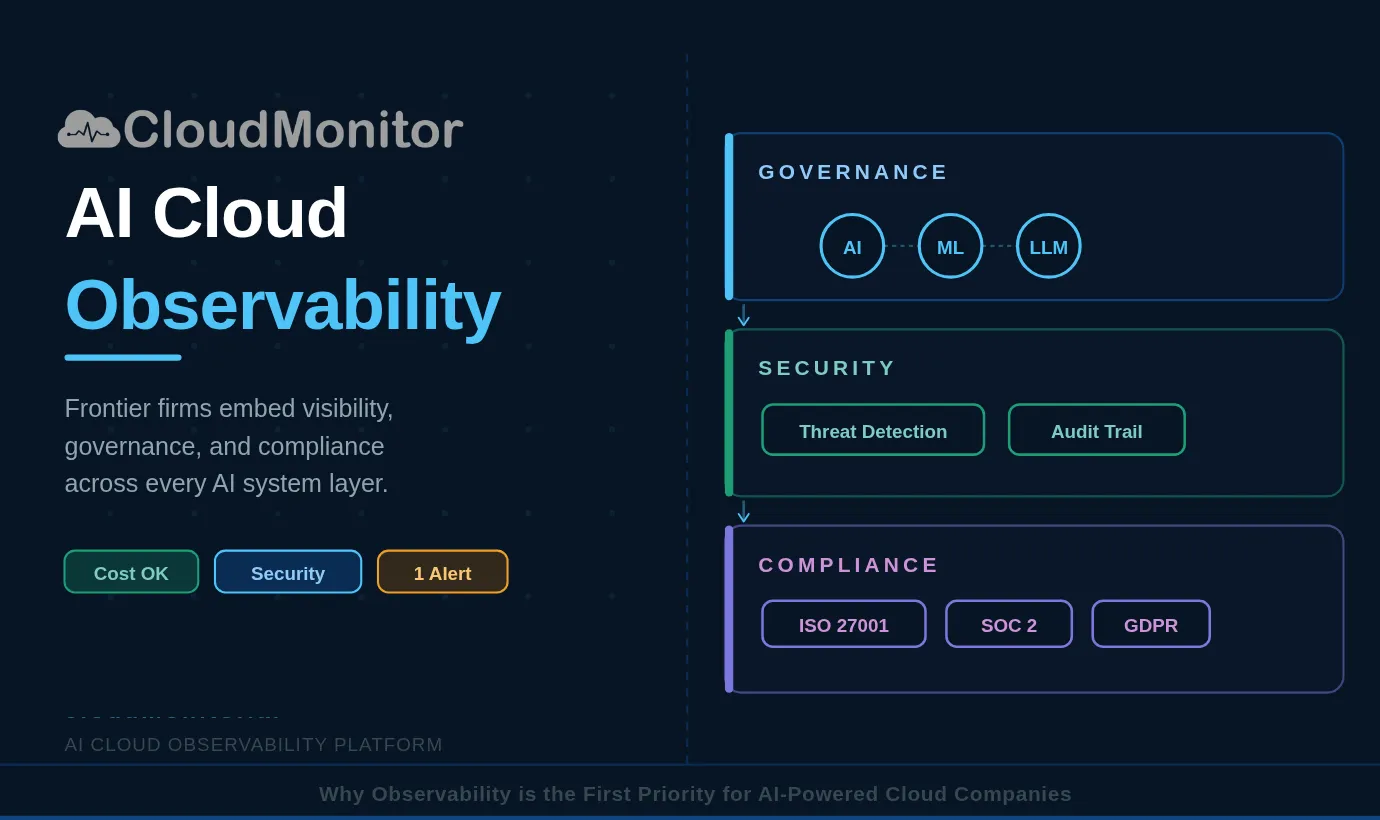
AI cloud observability is the foundation that separates high-performing cloud companies from those that struggle to maintain control as their AI systems scale. As organizations deploy machine learning models, autonomous agents, and AI-driven pipelines across complex cloud environments, visibility into every layer is no longer a luxury. It is the first line of defense.
Frontier firms have recognized this shift. They are not waiting for something to go wrong before investing in observability. They are embedding it from the ground up, treating governance, security, and compliance as non-negotiable components of every AI workload they run.
The question is no longer whether your organization needs AI cloud observability. The question is how quickly you can make it a core capability.
What Is AI Cloud Observability?
AI cloud observability goes beyond traditional monitoring. Where monitoring tracks predefined metrics, observability gives teams the ability to understand the internal state of a system from its external outputs.
In the context of AI-powered cloud environments, this means surfacing insights across model performance, infrastructure health, cost drivers, data pipelines, and compliance signals, all in one unified view.
It encompasses three core pillars: logs, metrics, and traces. Together, these pillars give engineering and FinOps teams a complete picture of how AI workloads are behaving, where inefficiencies exist, and whether systems are operating within governance boundaries.
For organizations operating in regulated industries such as finance, healthcare, or government, this level of visibility is directly tied to compliance obligations. Without it, audit trails are incomplete, anomalies go undetected, and risk exposure grows silently.
Why Frontier Firms Put Observability First?
The most advanced cloud organizations treat observability as a product discipline, not an afterthought. They understand that as AI systems become more complex and autonomous, the margin for blind spots shrinks dramatically.
Governance Built Into Every Layer
Frontier firms do not bolt governance onto their AI systems after deployment. They design it in at every layer. This means setting role-based access controls, tagging resources consistently, enforcing policy guardrails, and tracking model lineage from training data through to production outputs.
Research from Gartner on AI governance frameworks highlights that organizations without structured governance face significantly higher regulatory and reputational risks. Embedding governance into AI cloud observability workflows closes this gap proactively, rather than reactively.
Security and Compliance Visibility
Security threats in cloud environments are increasingly targeting AI workloads. From model poisoning to data exfiltration, the attack surface has expanded considerably. Observability platforms that surface anomalies in real time allow security teams to act before a vulnerability becomes a breach.
Compliance visibility is equally critical. Whether an organization must adhere to ISO 27001, SOC 2, or GDPR, having a continuous and auditable view of system behavior reduces the burden of manual compliance checks and supports faster audit responses.
The Real Cost of Poor AI Cloud Observability
When observability is an afterthought, the consequences compound quickly. Teams spend hours troubleshooting incidents they cannot trace to a root cause. Cost anomalies in cloud spending go undetected until they appear on a monthly invoice. Model drift accumulates unnoticed, degrading the quality of AI-driven decisions over time.
The FinOps Foundation identifies cloud visibility as one of the core capabilities required for effective cloud financial management. Without accurate, real-time data on how AI workloads consume resources, optimizing spend becomes guesswork rather than strategy.
Organizations looking to align observability with cloud cost management can explore CloudMonitor.ai’s FinOps capabilities to see how real-time visibility translates directly into cost savings and smarter resource decisions.
Embedding AI Cloud Observability Across FinOps Workflows
The most effective approach to AI cloud observability integrates monitoring across both engineering and finance workflows. When platform teams and FinOps practitioners share the same observability data, they make faster, more informed decisions about resource allocation, scaling, and cost optimization.
This unified approach also supports capacity planning. By correlating AI model usage patterns with infrastructure costs, organizations can forecast demand more accurately and avoid over-provisioning or under-provisioning cloud resources.
Platforms such as Microsoft Azure Monitor provide foundational telemetry capabilities, but organizations running sophisticated AI workloads often need a purpose-built layer on top. One that maps observability signals directly to business outcomes and governance requirements.
How CloudMonitor.ai Delivers AI Cloud Observability?
CloudMonitor.ai is built for organizations that are serious about understanding their cloud environments at every level. The platform provides real-time visibility across costs, performance, governance, and compliance, giving teams the intelligence they need to manage AI workloads with confidence.
From automated anomaly detection to detailed FinOps dashboards, CloudMonitor.ai makes it straightforward to embed observability into daily workflows. Whether a team is managing a single cloud account or a complex multi-cloud environment, the platform scales to meet the challenge.
Learn more about how CloudMonitor.ai approaches cloud governance for AI-powered businesses, including how policy enforcement and real-time alerting work together to keep systems compliant and cost-efficient.
For a full overview of the platform, visit the CloudMonitor.ai platform overview to discover how AI cloud observability, FinOps, and governance converge in a single solution.
READY TO SEE YOUR CLOUD WITH FULL CLARITY?
CloudMonitor.ai gives AI-powered cloud companies real-time observability across costs, performance, governance, and compliance. Stop flying blind. Start making smarter decisions today.
Keep reading
Cloud Computing
Integrating FinOps into AI/ML Pipelines for Smarter Spend
How to integrate FinOps into AI and ML pipelines — cost-aware experimentation, training-job tracking, and the spend signals that reach data scientists.

Cloud Computing
How to Use Spot Instances Safely for Reliable Cloud Performance
How to use spot instances safely — workload selection, eviction handling, and the architectural patterns that keep performance reliable on spot pricing.

Cloud Computing
The Benefits of Real-Time Cloud Analytics
The case for real-time cloud analytics in modern enterprises: faster decisions, immediate anomaly detection, and continuous optimization at scale.