finops
FinOps Cloud+: The Foundation's Shift Beyond Public Cloud
FinOps Cloud+ — the FinOps Foundation's expansion beyond public cloud into SaaS, data centres, AI, and licensing. What it means for Azure teams.
Why the FinOps Foundation Is Expanding Beyond Cloud Infrastructure?
FinOps Cloud+ is the most significant shift in the FinOps discipline since its founding, and if your organization is managing Azure spend today, it directly affects how you should be thinking about governance, tooling and executive alignment.
In early 2026, the FinOps Foundation made it official. Its mission changed from “advancing the people who manage the value of cloud” to “advancing the people who manage the value of technology.” One word. Cloud became Technology. And that single change carries enormous implications for every practitioner, finance leader and CTO working with cloud infrastructure today.
This is not a rebrand. It is a reflection of what FinOps teams are already doing on the ground, and a signal that the practice is being asked to do considerably more.
What Is FinOps Cloud+, Exactly?
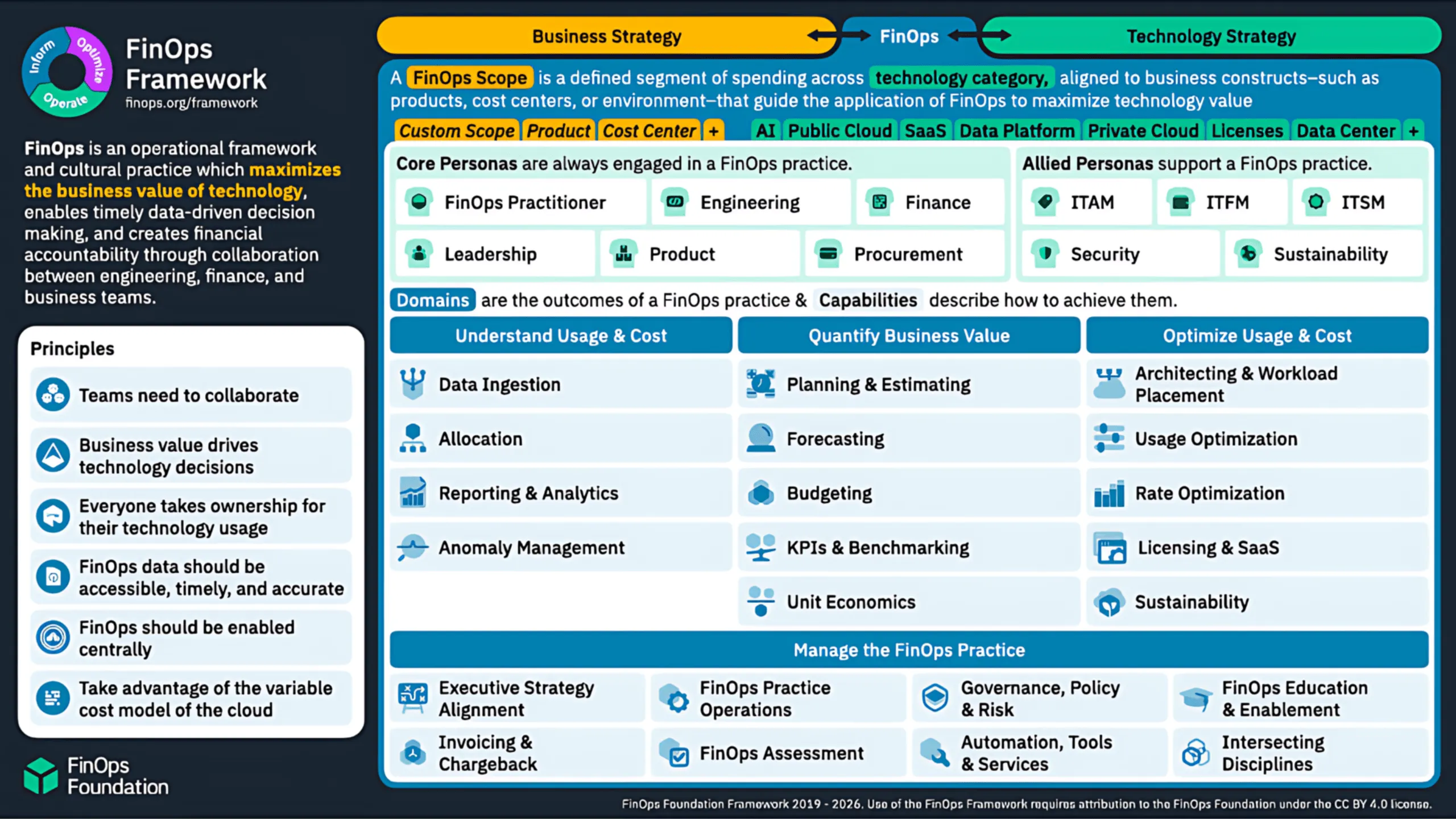
The term FinOps Cloud+ describes the expansion of FinOps practice beyond public cloud infrastructure into a broader set of technology spending categories. It is formalized through the introduction of FinOps Scopes in the FinOps Framework.
According to the FinOps Foundation 2026 Framework update, a FinOps Scope is defined as a defined segment of spending across technology categories, aligned to business constructs. The initial Scopes identified by the Foundation are:
- Public Cloud (the original and primary Scope)
- SaaS (software-as-a-service platforms such as Microsoft 365, Salesforce and Workday)
- Data Center (on-premises and colocation infrastructure)
- AI and machine learning workloads
- Licensing and software contracts
Importantly, the Foundation does not define or limit the possible Scopes. Organizations create their own Scopes based on the mix of technologies and spend that is relevant to their business objectives. That flexibility is deliberate, and it reflects the reality that no two technology estates look the same.
The Numbers Behind the FinOps Cloud+ Shift
The data underpinning this shift is striking. According to the State of FinOps 2026 report, drawn from more than 1,200 organizations representing over $83 billion in annual technology spend:
- 98% of FinOps practitioners now manage AI spend. Two years ago that figure was 31%.
- 90% now manage or plan to manage SaaS spend, up 25% year-on-year.
- 64% manage licensing and software contracts.
- Nearly half have data center costs back in scope.
- 28% have even begun including labor costs in their FinOps remit.
These numbers confirm something many practitioners have felt for some time. The boundaries of FinOps have been expanding organically, driven by business leaders who have seen the value of the discipline and asked their teams to apply it elsewhere. The Foundation has now formally acknowledged that reality.
Executive Alignment: FinOps Moves Into the CTO’s Office
From back-office to boardroom
One of the most consequential changes documented in the 2026 State of FinOps report is the shift in where FinOps sits within organizations. More than 78% of FinOps teams now report directly into the CTO or CIO organization, up 18% since 2023. Reporting to the CFO has fallen to just 8%.
This is not simply a change in reporting lines. It signals a fundamental repositioning of FinOps from financial reporting and cost policing into a strategic technology capability. FinOps leaders are now sitting in architecture review meetings, participating in vendor selection and shaping investment decisions before commitments are made.
Executive Strategy Alignment as a formal capability
The FinOps Framework 2026 formalizes this shift by introducing Executive Strategy Alignment as a new capability in the Manage the FinOps Practice domain. It reflects the expectation that FinOps practitioners are not just reporting on spend after the fact. They are bringing data, consistent allocation models and clear value narratives that help executives make better decisions across cloud, AI, SaaS and licensing.
For Azure-focused teams, this is particularly relevant. Azure environments are often the largest single line item in an organization’s technology budget, and the ability to present Azure cost data in a business context, linked to products, projects or cost groups, is exactly what executive stakeholders are asking for.
What FinOps Cloud+ Means for Azure Teams Specifically?
Cloud optimization remains the foundation
It is worth being clear on one point. The Cloud+ direction does not diminish the importance of public cloud optimization. For the vast majority of organizations, Azure remains the primary Scope and the biggest source of both cost and opportunity.
Waste reduction, right-sizing virtual machines, anomaly detection and budget governance are still the most immediately actionable FinOps activities. The Cloud+ framework simply provides the architecture to extend those same disciplines further across the technology estate as the practice matures.
Automation becomes non-negotiable
As FinOps Scopes expand, the volume of cost and usage data that teams are expected to manage grows substantially. Manual processes built for cloud-only environments cannot scale to cover SaaS, AI, licensing and data center simultaneously. Automation is no longer a nice-to-have. It is the operational baseline.
This is where a tool like CloudMonitor becomes particularly valuable. By automating
automated Azure cost governance, delivering cost-saving recommendations and right-sizing in real time, and providing the kind of cost allocation and chargeback reporting that executive stakeholders require, CloudMonitor supports teams as they transition from reactive cloud management into a mature Cloud+ practice.
The FinOps Framework’s updated Capabilities, including renamed Usage Optimization and Governance, Policy and Risk, are built around this exact model: systematic, automated, and aligned to business strategy rather than just technical outputs.
How to Prepare Your FinOps Practice for Cloud+?
The Cloud+ shift does not require organizations to overhaul everything overnight. The Foundation is explicit that public cloud remains the primary Scope and that expansion is driven by business priorities, not a prescriptive checklist. That said, there are practical steps Azure teams can take now.
- Audit your current FinOps Scope. What technology spend categories are you currently governing? Where are the visibility gaps?
- Strengthen your Azure foundation first. Mature cost allocation, tagging discipline and automated anomaly detection in Azure before attempting to extend governance to SaaS or AI.
- Identify executive stakeholders. Cloud+ FinOps requires buy-in from CTO and CIO leadership. Start building those relationships with clear cost visibility and value narratives.
- Evaluate your tooling. Can your current platform generate the normalized, consistent data needed to report across multiple Scopes? If not, that is the first investment to prioritize.
- Start with SaaS. For most organizations, SaaS is the natural second Scope after public cloud. Centralizing SaaS cost and usage data and allocating it to departments is a manageable and high-value first step.
To understand how CloudMonitor’s approach aligns with this evolution, see how CloudMonitor works inside an Azure environment.
The Bottom Line on FinOps Cloud+
FinOps Cloud+ is not a future concept. It is already how most mature FinOps teams operate. The FinOps Foundation has simply caught up to the reality that practitioners have been living for the past two years.
For Azure teams, the immediate practical takeaway is this: get your public cloud house in order first. Automate governance, eliminate waste, establish clear cost allocation, and build the executive relationships that come from delivering accurate and actionable data. That foundation is what makes Cloud+ expansion possible.
The organizations that invest in that foundation now, before being asked to extend FinOps to AI, SaaS and beyond, will be the ones best positioned to deliver technology value at scale in 2026 and beyond.
Is Your Azure Practice Ready for Cloud+?
CloudMonitor automates your Azure FinOps practice 24×7 and gives you the visibility, governance and cost-saving recommendations needed to expand into a true Cloud+ model. See it in action with our free live demo.
Try the Live FinOps Demo: cloudmonitor.ai/try-live-cloudmonitor-demo
Keep reading
Finops Framework
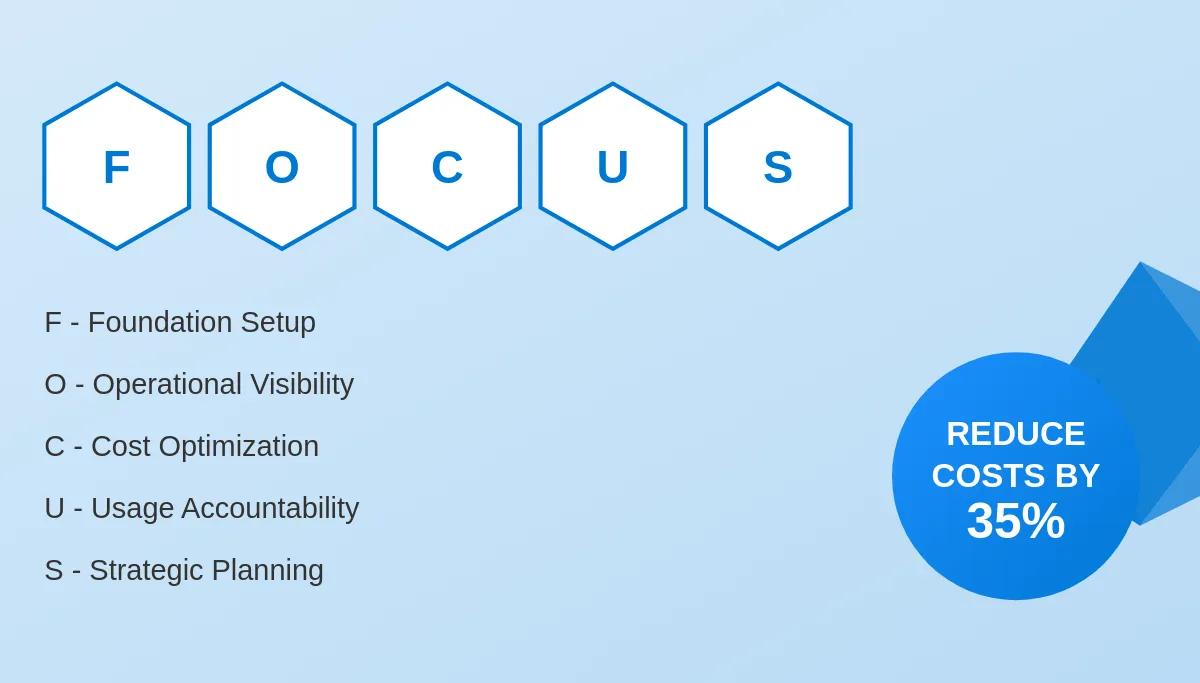
Implementing the FOCUS Specification for Azure
How to implement the FOCUS specification on Azure: tagging policies, cost allocation, and the structure that brings clarity to multi-cloud billing.

Cost Optimization
AI-Driven Cloud Monitoring for Hybrid and Multi-Cloud
AI-driven monitoring for hybrid and multi-cloud: how machine learning unifies visibility, simplifies operations, and surfaces cost waste in real time.
Finops
FinOps Framework 2026 Explained for Azure Users
FinOps Framework 2026 explained for Azure users — what's new, how to apply it, and the structural shifts that broaden FinOps beyond cloud spend.