announcement
Bringing FinOps To Microsoft Fabric: CloudMonitor Workload Launches
Data-Driven AI launches CloudMonitor for Microsoft Fabric, bringing FOCUS 1.0 cost governance and AI tokenomics directly into your workspace.
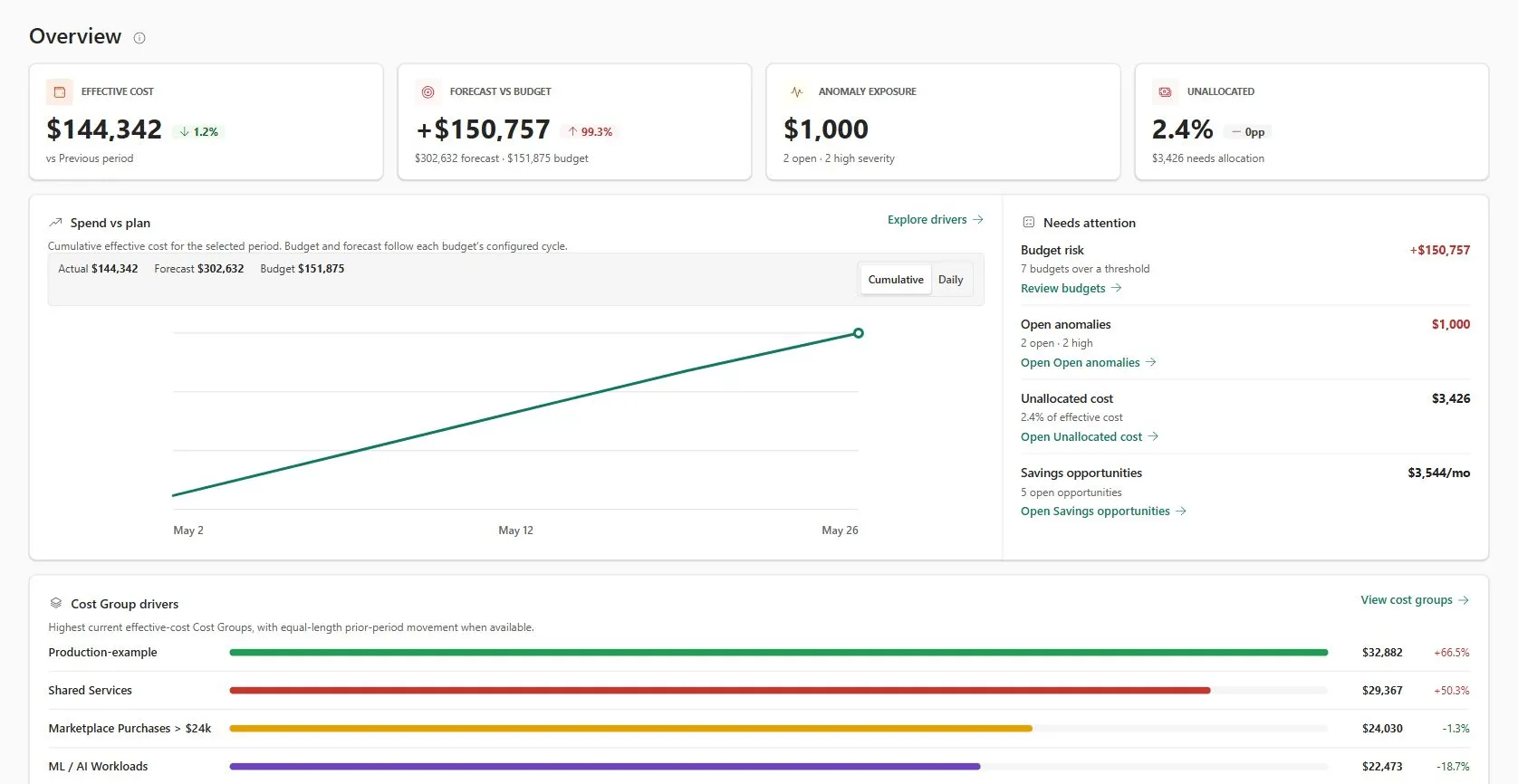
Data-Driven AI has launched CloudMonitor FinOps & AI Tokenomics as a custom workload for Microsoft Fabric, available in the Workload Hub. The release is backed by Microsoft Marketplace SaaS offer, enabling direct procurement through existing Microsoft Azure Consumption Commitments (MACC). This public preview milestone coincides with the European Microsoft Fabric + SQL Community Conference .
Built with the Microsoft Fabric Extensibility Toolkit (FET), CloudMonitor embeds FOCUS 1.0 financial intelligence into the daily analytics environment. Data engineers, analytical architects, and business teams can now inspect capacity usage and AI model costs alongside their production pipelines.
The Operational Problem: Fragmented Portals and Silent Cost Growth
Cloud budgets and generative AI consumption expand faster than the engineering context required to govern them. Analytics leaders orchestrate compute-heavy pipelines in Microsoft Fabric while machine learning engineers deploy endpoints in Microsoft Azure OpenAI. Meanwhile, finance teams receive aggregated monthly invoices that fail to explain why a mid-month variance occurred.
Switching between disconnected management consoles creates operational friction, CloudMonitor addresses that friction via its custom Fabric workload built using Fabric’s Extensibility Kit (FET). When engineers must leave Microsoft Fabric to open an external billing portal, cost reviews turn into retrospective audits. Critical operating context gets lost across functional silos:
- Compute capacity spikes remain untied to specific notebook executions or pipeline runs.
- Token consumption across models remains buried in flat, resource-level meters.
- Finance teams lack visibility into interactive versus background smoothing workloads.
- Shared infrastructure costs remain unallocated or grouped into generic overhead pools.
Treating cost governance as a periodic post-mortem creates compounding technical debt. At Data-Driven AI, we treat cost governance as an architectural design input rather than an afterthought. Engineering teams need accurate cost and usage telemetry inside their active development workspace.
Why a Microsoft Fabric Workload
CloudMonitor is built natively using the Microsoft Fabric Extensibility Toolkit (FET). Rather than requiring another browser tab, standalone login, or external SaaS dashboard, CloudMonitor instantiates as a first-class workload item directly inside customer Fabric workspaces.
Engineers launch CloudMonitor adjacent to Lakehouses, Notebooks, Warehouses, and Data Pipelines. This native placement removes context switching. Practitioners inspect capacity consumption, burn rates, and budget allocations in the same workspace where they build solutions.

Deployment requires zero external infrastructure. Once read-only Microsoft Entra permissions are granted, CloudMonitor catalogs workspaces, capacities, and item hierarchies across tenant scopes. Up to 30 days of historical Capacity Unit (CU) consumption, interactive smoothing telemetry, and Azure billing data hydrate into the workspace. Teams can review sample data in the interactive preview while background synchronization completes.
To learn more about how custom workloads integrate into the platform, review the official Microsoft Fabric Workloads documentation on Microsoft Learn.
Architectural Deep Dive: Customer Boundary Data Sovereignty
Enterprise data sovereignty is a non-negotiable architectural requirement for government departments and regulated commercial organizations. Traditional third-party FinOps tools export raw billing records, subscription topologies, and resource metadata to external vendor clouds. That external data transfer introduces compliance reviews, security friction, and audit risk.
CloudMonitor is engineered for strict customer data sovereignty:
- Zero external data egress: All data processing executes entirely within the customer Microsoft tenant and Fabric workspace boundary. Proprietary infrastructure metadata, billing line items, and usage metrics never leave your security perimeter.
- OneLake storage foundation: Ingested telemetry is stored as Delta Parquet tables inside your OneLake boundary. Your data engineering teams retain complete ownership and direct query access to their underlying datasets.
- Direct Lake semantic models: Dashboards connect through Direct Lake mode, running queries directly against OneLake Parquet files without requiring data replication or memory cache refreshes.
- Strictly read-only evaluation: CloudMonitor functions exclusively as a read-only analytics workload. It requests no write permissions to production resources, isolating governance reporting from operational execution.
This architecture satisfies strict enterprise compliance standards. Data-Driven AI holds ISO 27001, ISO 9001, and ISO 42001 certifications. We ensure cloud financial governance operates with the same security isolation applied to mission-critical analytics estates.
Connecting FinOps to AI Tokenomics
Modern analytics estates run mixed computational and generative AI workloads. Microsoft Fabric environments frequently run alongside Microsoft Azure OpenAI deployments, custom agents, and Microsoft 365 Copilot seats. Managing these workloads requires moving beyond aggregate infrastructure spend into granular unit economics.
CloudMonitor unites cloud financial management with AI tokenomics:
- FOCUS 1.0 standard alignment: Financial metrics normalize to the FinOps Open Cost and Usage Specification (FOCUS 1.0), establishing common accounting schemas across Azure subscriptions and Fabric compute.
- Prompt and completion token tracking: Monitor token volumes, model types, and invocation patterns across Microsoft Azure OpenAI, GitHub Copilot, and foundational models.
- Unit economics by application and team: Calculate the exact cost per query, cost per business transaction, and cost per generated output, attributing spend to responsible teams.
- Root-cause cost attribution: Trace month-over-month cost variances from high-level summaries down to individual resource groups, subscriptions, and resource owners.
- Automated showback and chargeback: Rule-based Cost Groups and virtual tagging normalize inconsistent tagging schemas and allocate shared tenant resources accurately.
- Budget forecasting and anomaly triage: Compare real-time burn rates against dynamic forecast models. Anomaly detection flags usage deviations early, routing actionable alerts directly to workload owners.
Customer Zero: Grounded in Production Delivery
Data-Driven AI delivers data platforms with an intentional philosophy: we are Customer Zero for our own engineering accelerators. We operate our own business on the same agents, data pipelines, and cost governance frameworks that we deploy for clients. Our internal licensing, finance administration, and partner sales run on custom agents. CloudMonitor was built and refined internally to govern our own Azure and Fabric infrastructure before being released to the market.
Our credentials reflect that deep delivery specialization:
- One of only 13 Australian partners holding the Microsoft Azure Analytics Advanced Specialization alongside Security and Data & AI designations.
- Official Microsoft Fabric Featured Partner.
- FinOps Foundation General Partner with an accredited FinOps Certified Solution.
- Certified under ISO 27001 (Information Security), ISO 9001 (Quality Management), and ISO 42001 (Artificial Intelligence Management).
This delivery experience is validated by published customer results across enterprise and government environments:
- Transport for NSW: Built an Azure Operational Data Lake ingesting 500 GB and millions of vehicle telemetry files daily, cutting data lake OPEX by 22% while providing self-service access to historical transit data.
- Clinic to Cloud: Conducted an Azure and DevOps optimization review that reduced overall Azure spend by 46% within two weeks of baseline implementation.
- NSW DCCEEW: Modernized the Biodiversity Offset Scheme using Microsoft Fabric, consolidating data pipelines into a medallion lakehouse architecture feeding governed Power BI reporting.
How to Get Started
CloudMonitor FinOps & AI Tokenomics is available in the Fabric Workload Hub for deployment inside your Fabric tenant.
You can explore and activate the workload through the following resources:
- Deploy in Microsoft Fabric: Microsoft Fabric Workload Hub Listing
- Procure on Azure Microsoft Marketplace: CloudMonitor Microsoft Marketplace SaaS Offer
- Explore Live Sample Data: Interactive CloudMonitor Demo
- Review Plans and Pricing: CloudMonitor Pricing Details
- Read Setup Guides and Documentation: CloudMonitor Documentation and Deployment Guides
Whether you are consolidating Fabric Capacity Units, attributing shared lakehouse costs, or tracking token consumption across generative AI models, CloudMonitor provides the financial clarity your teams need directly within their workspace.
Keep reading
Announcement
Data-Driven AI Launches CloudMonitor FinOps Workload for Microsoft Fabric
Built with the Microsoft Fabric Extensibility Toolkit and backed by a Microsoft Marketplace SaaS offer, CloudMonitor provides FOCUS-aligned Azure and Fabric cost intelligence directly inside the Fabric workspace.
Finops
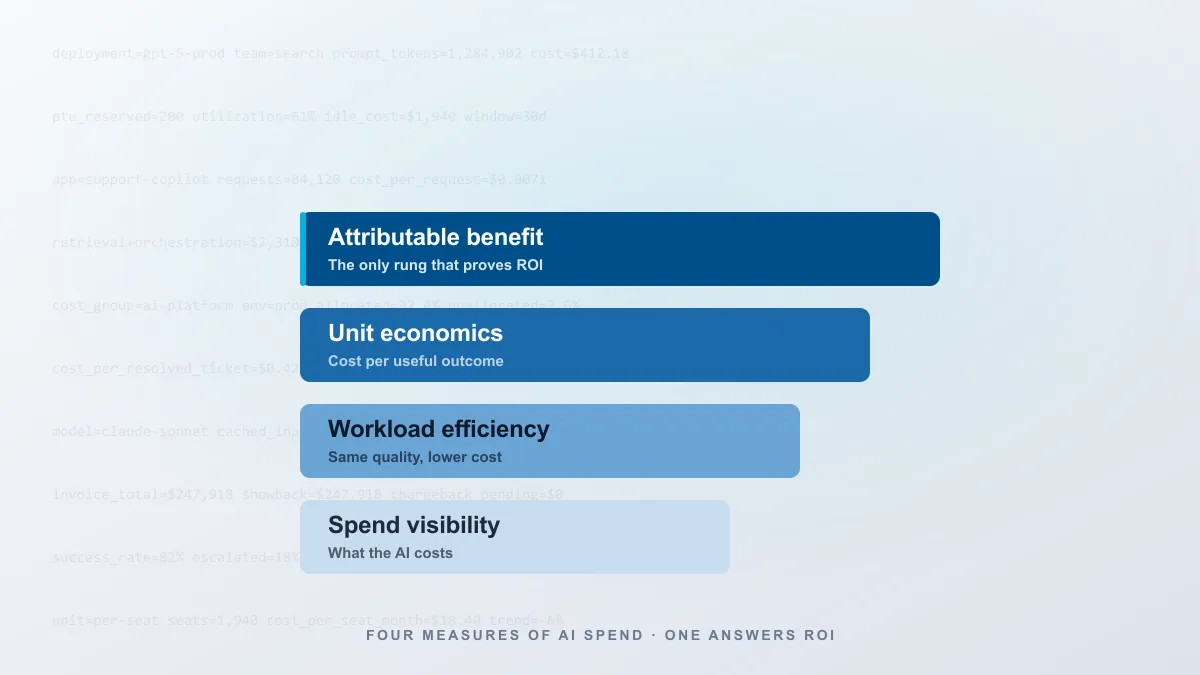
AI ROI: What cost data can—and cannot—prove
Build a defensible ROI calculation by separating spend visibility, workload efficiency, unit economics, and attributable business benefit.

Cloud Computing
Adapting to AWS's Ban on Discounted RI Marketplace Sales
AWS now prohibits selling discounted Reserved Instances on the Marketplace. What the policy change means for your RI strategy and how to adapt.