finops
AI ROI: What cost data can—and cannot—prove
Build a defensible ROI calculation by separating spend visibility, workload efficiency, unit economics, and attributable business benefit.
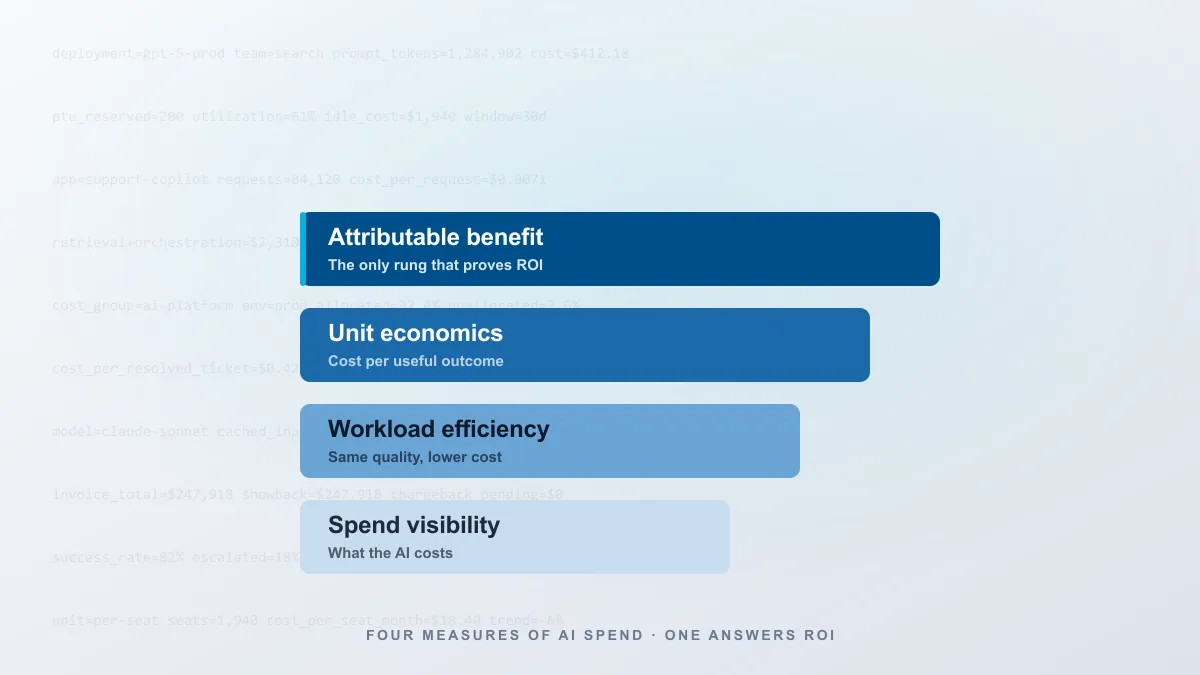
AI cost data cannot prove a return on its own. It shows the size of the investment. Usage data can reveal waste and efficiency. To calculate ROI, you also need successful outcomes and the financial benefit caused by the AI.
Each measure answers a different question.
Build a trusted cost baseline
AI cost management has become standard FinOps work. The State of FinOps 2026 Report says 98% of FinOps teams manage AI spend, up from 31% in 2024, across 1,192 organizations.
Visibility is still necessary. Teams need to know which provider, model, deployment, application, seat, GPU, or PTU drove the charge. They also need to include surrounding costs such as retrieval, orchestration, infrastructure, licenses, and operations.
A provider invoice may not contain enough business context to make that allocation. Preserve the product, team, environment, and cost-group context when a request runs. Then reconcile the resulting view with the bill.
Separate efficiency from business value
Efficiency asks whether a workload can meet the same quality and service target at a lower cost. Useful review signals include:
- Model choice. Could a less expensive model handle the task without reducing quality?
- Caching and batching. Could repeated input be cached, or delay-tolerant work be batched?
- Seat activity. Are paid licenses active enough to justify renewal?
- GPU and PTU capacity. Does utilization match the workload’s latency, throughput, and availability needs?
These signals help teams find candidates for review. They are not proof of realized savings. Confirm the result against actual spend and service quality after each change.
Output tokens per dollar also need care. The ratio measures throughput, not usefulness. A verbose response can score well while producing a worse result.
Calculate cost per outcome
Unit economics joins all workload costs to a successful outcome the business already trusts. Include provider charges, infrastructure, licenses, and operating work. The outcome might be a resolved ticket, an accepted code review, or a completed document that passed a quality check.
The denominator should come from the system that records the work. It also needs a clear definition. For example, “ticket resolved” may need to exclude reopened tickets or include a customer-satisfaction threshold.
Cost per successful outcome is useful, but it is not ROI. It tells you how economically the work was produced. It does not say what the outcome was worth.
CloudMonitor measures the cost and efficiency side where billing and usage sources are connected. Use Unit Economics to track cost per business measure; determining ROI still requires attributable benefit data. See the consolidated FinOps for AI measurement model.
Add attributable benefit
ROI compares the benefit caused by the investment with its total cost:
ROI = (attributable realized benefit − total AI investment cost) ÷ total AI investment cost.
Use the same measurement period for both sides. Define a baseline or a comparison without the AI. Keep the quality threshold stable and include the full investment cost. That can include implementation, integration, review, governance, training, and ongoing operations.
The difficult part is attribution. A faster team may also have changed its process, hired staff, or received easier work. Claim only the share of benefit that the evidence can reasonably connect to the AI investment.
Include capacity in AI cost
For Azure workloads, a large part of the cost may sit in capacity rather than tokens. Azure OpenAI Provisioned Throughput is billed as provisioned capacity. Its break-even point depends on observed throughput, traffic shape, price, and service requirements.
Low utilization is not automatically waste. Unused capacity may provide headroom for latency, throughput, or availability. If a workload uses configured spillover to a standard deployment, include its cost and service tradeoff in the comparison.
CloudMonitor reconciles Azure cost to a FOCUS-conformed billing model. That gives finance and engineering a common cost baseline. Business outcome data still has to complete the ROI case. See FinOps for Microsoft AI for the Microsoft-estate view.
Start with one outcome
First, assign the full AI cost to a workload and owner. Next, review efficiency while holding quality and service targets steady. Then choose one success measure the business already records.
Track the cost of each successful outcome over a stable period. Add financial benefit only when the baseline and evidence support it. This order creates an ROI case that people can audit.
Want to inspect the cost side on your own tenant? Get started or see the demo.
Keep reading
Announcement
Data-Driven AI Launches CloudMonitor FinOps Workload for Microsoft Fabric
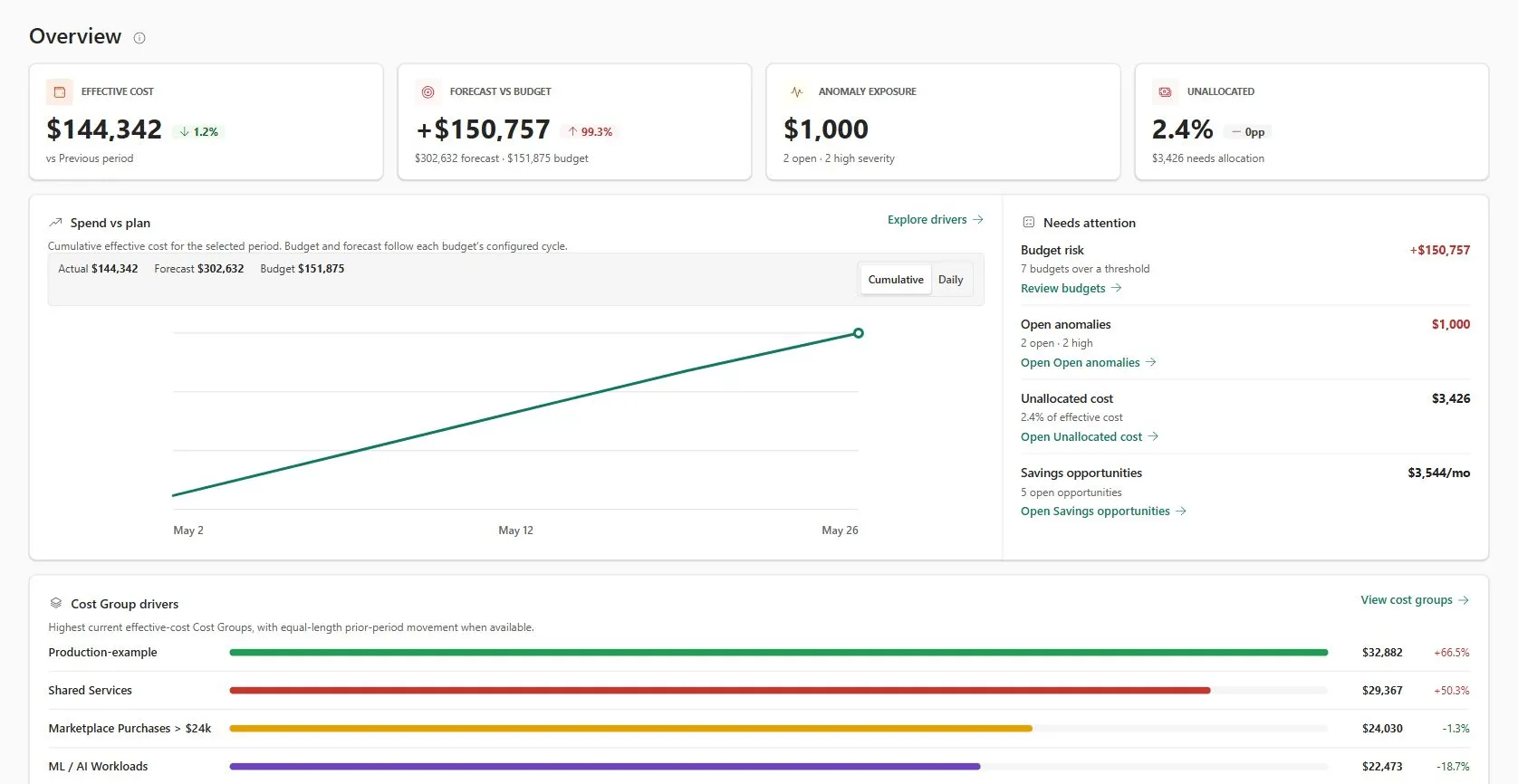
Built with the Microsoft Fabric Extensibility Toolkit and backed by a Microsoft Marketplace SaaS offer, CloudMonitor provides FOCUS-aligned Azure and Fabric cost intelligence directly inside the Fabric workspace.
Announcement
Bringing FinOps To Microsoft Fabric: CloudMonitor Workload Launches
Data-Driven AI launches CloudMonitor for Microsoft Fabric, bringing FOCUS 1.0 cost governance and AI tokenomics directly into your workspace.
Announcement
CloudMonitor adds Copilot, OpenAI, Claude, and Cursor connectors
Four new AI provider connectors land in CloudMonitor — covering the developer tools and APIs driving the fastest-growing line on the 2026 cloud bill.