Microsoft Fabric costs fabric
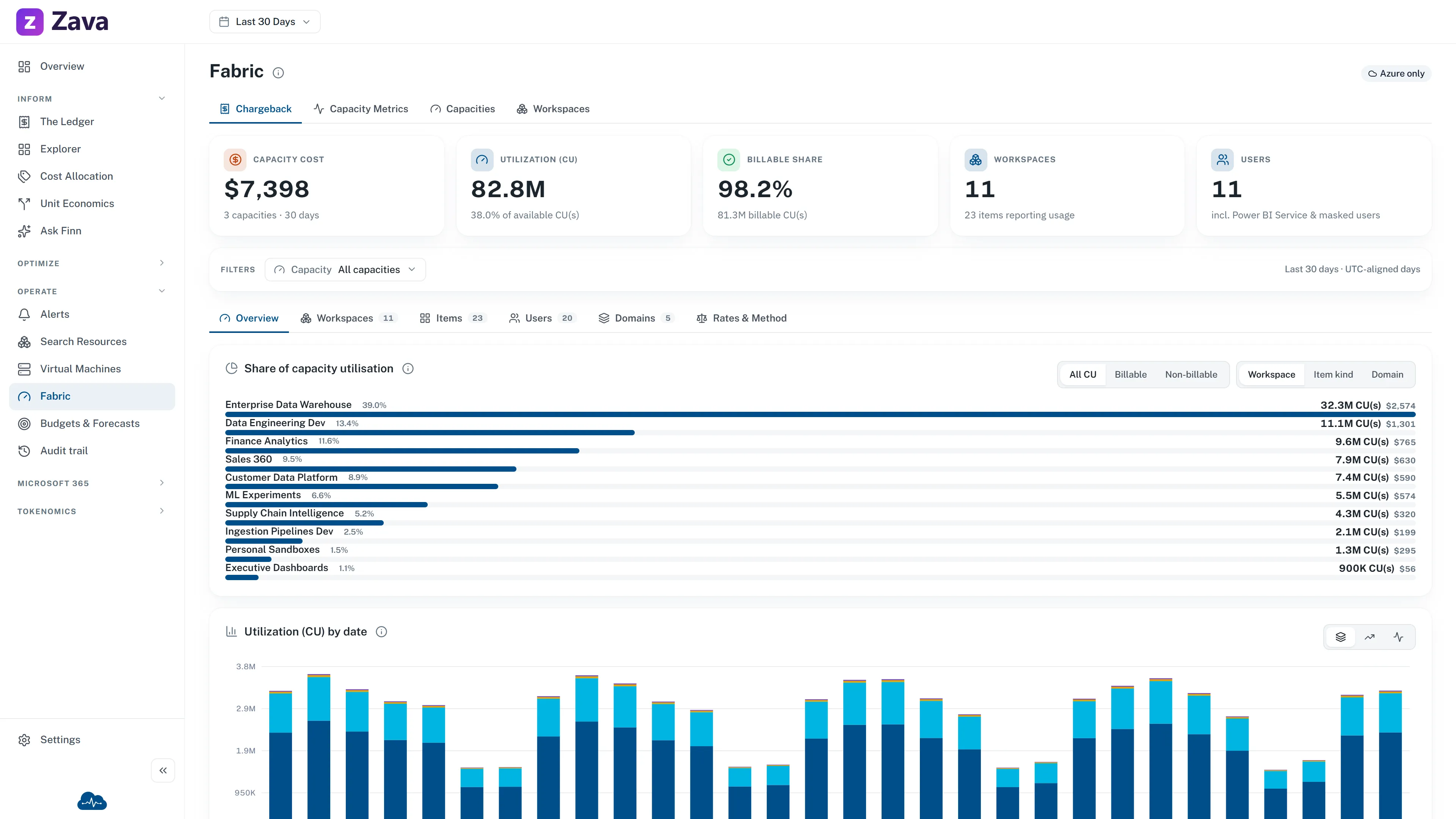
Microsoft Fabric is billed as capacity — you buy a pool of compute and everyone’s workspaces draw from it. That makes it awkward to attribute: one invoice line, many teams.
This report unpicks it.
The tabs
Section titled “The tabs”Chargeback — capacity usage by workspace, item, domain and user, priced against the bill. This is the tab that turns one capacity charge into per-team numbers you can actually hand out.
Capacities — your Fabric capacity inventory: size, region, state, which workspaces are assigned to each, and what it costs. Each opens in Fabric or Azure.
Workspaces — governance across the tenancy: what exists, when each was last active, who’s likely using it, and cleanup commands for the ones that aren’t.
Workspaces is where the easy money is
Section titled “Workspaces is where the easy money is”Fabric capacity is bought ahead of use, so an abandoned workspace doesn’t produce a visible charge — it consumes headroom, and you notice when you’re asked to buy more.
Sorting by last activity and looking at the stale end is a five-minute job that regularly pays for itself. A workspace nobody has opened in six months is a conversation, not necessarily a deletion.
A tab you may not have
Section titled “A tab you may not have”Capacity Metrics — utilization, throttling, overages and storage — is an optional module. If it isn’t in your tabs, it isn’t switched on for your workspace; an admin can enable Fabric Monitoring under Settings ▸ Workspace Settings ▸ Features.
Chargeback, Capacities and Workspaces are unaffected either way.
Filters
Section titled “Filters”Period and cost basis drive the capacity cost figures.
Provider is grayed out — Fabric capacity is Microsoft-only. Cost group and virtual tags don’t apply yet either: Fabric usage isn’t allocated to cost groups, and its telemetry carries no resource tags. The chips say so rather than doing nothing quietly.
That last one is worth planning around. If you want Fabric costs inside a team’s cost group total today, that attribution has to come from the Chargeback tab rather than from the cost group filter.
The page’s own toggle
Section titled “The page’s own toggle”The Chargeback tab has a control for how capacity usage is attributed. It’s independent of the global filters — it picks the attribution method, not the scope — so changing it changes how the same total is divided, never the total itself.