TokenMaxing
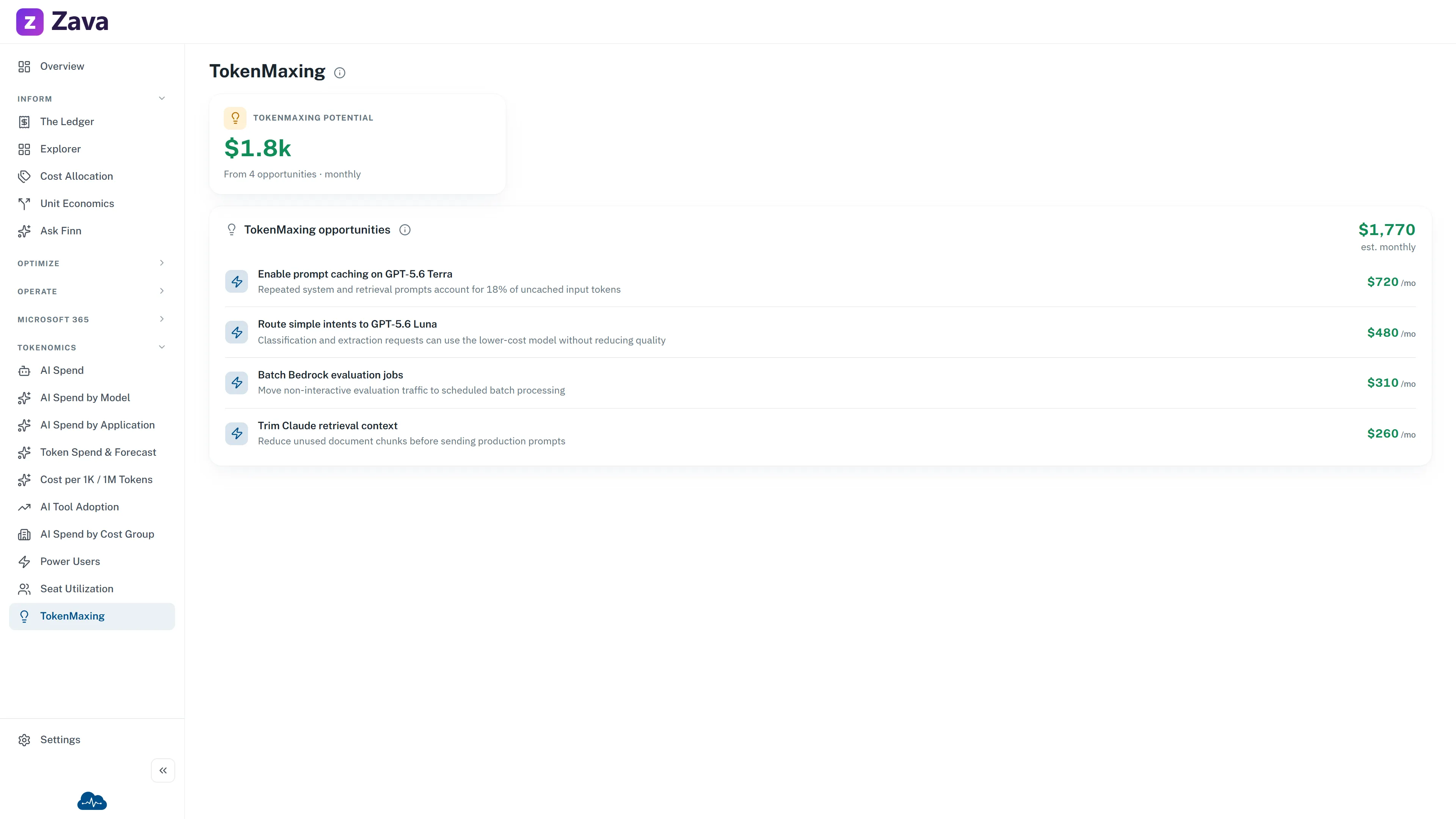
Savings & Waste for AI. Where that screen finds oversized virtual machines, this one finds inefficient token use — ranked by what each change would save.
The four levers
Section titled “The four levers”Caching. Repeated context re-sent on every call is charged every time. Caching it is usually the single biggest win and needs no change to what the application does.
Routing. Sending every request to the most capable model is the AI equivalent of running everything on the largest instance size. Route the simple work elsewhere.
Downshifting. The same idea applied to a specific workload that has outgrown the need for a frontier model.
Batching. Many providers price batched or asynchronous work below real-time. Anything that doesn’t need an answer this second is a candidate.
None of these reduce what your AI does. That’s what separates them from “use AI less”, which is usually the wrong answer.
Read it as a prompt, not a promise
Section titled “Read it as a prompt, not a promise”The value here is the ranking and the type of opportunity. Treat a specific figure as an indication of scale, and confirm any real saving on AI Spend after you’ve made the change — cost per million tokens is the number that will actually move.
Who this is for
Section titled “Who this is for”Whoever can change how the application calls the model. Unlike a licence reclaim or a rightsizing, every item here is an engineering change — so this screen is a conversation starter with a team rather than something a FinOps practitioner actions alone.
Related
Section titled “Related”- AI Spend — what it costs today, and the unit rate to measure improvement against.
- AI tool adoption — whether you’re paying for tools and seats nobody uses, which is the cheaper problem to fix first.